Another Future is Possible
AI is the most powerful technology in human history - arriving into a world order already breaking down. Today I'm launching the Center for Tomorrow to help us find our way to the good future.


For almost two decades, I’ve been working at the intersection of technology and global affairs. I’ve worked for Elon Musk, Mark Zuckerberg, and Eric Schmidt, and for the last several years I’ve been at the heart of the AI revolution. I’ve written speeches for the UN Secretary-General and sat in mission control during SpaceX launches. I have been in rooms where decisions have been made that have helped shape the trajectory of our times.
But I was never supposed to be there. And since you might be tempted to click away once you’ve heard I worked for some of those names, let me take a moment to declare my allegiances.
My father was a refugee from Burma who fled the Japanese invasion as a four-year-old boy before growing up stateless in a refugee camp in India. My mother was an immigrant to a country she barely knew. We had no money, no connections. As a mixed-race child in 1980s England, I walked through a world where people would literally stop and point because they hadn’t seen kids who weren’t white. By the time I became the first in my family to earn a university degree, my entire life was driven by the pursuit of a single question: why did some people get the good life and billions of others didn’t - and could the systems that produced those outcomes be changed?
This is why I spent nearly two decades inside the centers of technology and power - not because I cared about product launches or IPOs or proximity to power, but because I was obsessed with how you could build a better world. My allegiance has always been to humanity, my interests always in how technology and the instruments of global power can tackle the biggest challenges facing ordinary people in all societies.
The decision to work within big, imperfect institutions - even highly flawed ones - is a deeply complex one, and throughout my career I increasingly wrestled with the tradeoffs that being at the heart of the tech industry involved. But fundamentally it came down to believing that these technological entities were doing something important for the world, and I had a responsibility in whatever miniscule way I could to try and push them in the right direction. Others made different choices, and I don’t fault them at all - just as I don’t fault you if you think I made the wrong choices. I just want you to understand some of my thought process here.
In October 2025, I left behind my time in Big Tech and started a very different chapter. Because what I had seen in those rooms, over those years, now made it impossible to stay. After nearly two decades watching it up close, I have reached a conclusion I can no longer keep to myself: we are not prepared for the world that is coming, and the path we are currently on leads to disaster.
Artificial intelligence, the most powerful general-purpose technology in human history, is arriving not into a stable, well-governed world but into one already ablaze with interlocking crises. Soaring economic inequality. Democratic institutions corroding. A geopolitical order fracturing. A climate emergency accelerating toward irreversible thresholds. These forces do not merely coexist - they compound each other. And AI, on its current trajectory, will amplify all of them. I believe the current future that we are heading for will not deliver a good life for the vast majority of people or countries.
But this outcome is not inevitable. The same technology could - with different choices, frameworks and political will - help resolve them. This decade does not have to be a downward slope of decline.
The odds are certainly stacked against us, and the window to change course is closing faster than almost anyone in power is willing to admit. I believe we have roughly ten years left to rethink many of the fundamental assumptions, institutions and choices that govern our societies before the pace of technology and disruption will decide for us. But we do have a chance. We have choices. And we have to try.
This is why I left behind my old life, and why today I am launching the Center for Tomorrow - a new global nonprofit dedicated to building the future we want, while we still can.
The Machine Accelerates

To understand what is at stake, you need first to grasp what is actually happening with artificial intelligence - not the hype, not the backlash, but the genuine transformation unfolding in real time.
The pace at which capabilities have advanced over the past few years has been genuinely extraordinary. Systems that could barely reason reliably in 2022 can now write sophisticated working code, pass professional licensing examinations, conduct graduate-level scientific reasoning, and perform legal, medical, and financial analysis at or above the level of trained human practitioners. From one model generation to the next the leaps have been so dramatic that researchers inside the leading labs sometimes struggle to keep up with the pace of advances across the industry. Last week, new model releases made the systems of six months ago feel almost quaint. The curve has not flattened.
Crucially, this is no longer about narrow, task-specific capability. The leading AI systems are converging on something genuinely general: a flexible cognitive capacity that can be applied across almost any domain involving language, reasoning, or pattern recognition. That shift is categorically different from anything that came before, and its implications for how human labor is valued - and how power is distributed - are profound.
The investment driving this is staggering. Four US tech giants are planning to spend up to $670 billion on AI infrastructure this year alone. That single-year figure dwarfs the Apollo program, the interstate highway system, and the railroad expansion of the 1850s combined. This is not a technology sector bet. It is a civilizational wager.
The productivity effects are already reshaping labor markets. While AI is now integrated into the majority of customer service workflows, full automation of these interactions remains a work in progress. Entry-level hiring in AI-exposed sectors has cooled by roughly 10% to 15% as firms prioritize experienced talent capable of leveraging these tools.
At the leading edge, AI is identifying novel drug candidates, generating breakthrough materials for solar energy and battery technology, and accelerating autonomous scientific experiments. Geoffrey Hinton, whose foundational work shared the Nobel Prize in Physics, has warned that predicting what these systems will be capable of in even two years has become genuinely difficult.
The warning signs within the technology community itself are significant. Dario Amodei, the CEO of Anthropic, one of the leading AI labs, has publicly warned about the scale of labor market displacement coming and the risks of extreme concentration of economic power. The anxiety is not just among critics - it runs through the heart of the industry. An OpenAI researcher recently left to write poetry, unable to continue working on systems she believed were developing faster than anyone was prepared to manage. Just two weeks ago, new AI capabilities from Anthropic triggered a days-long global stock sell-off across software, legal services, financial data, and real estate. This was not a crisis of AI failing. It was markets waking up to AI working exactly as intended - and beginning to price in what that means for the workers and industries in its path.
Yes, some claims are overhyped. Some demonstrations crumble under scrutiny. But the true picture is something more consequential than either hype or dismissal: a genuine, accelerating transformation of what machines can do - arriving into a world with no serious plan for what that means.
“The old world is dying. The new world struggles to be born.” - Antonio Gramsci
The World AI Is Crashing Into
Here is what the cheerleaders of AI consistently fail to reckon with. Technology doesn’t just change the world. The world changes technology. The values, institutions, and political choices that define our societies will determine whether the AI revolution produces a future of hope or one of devastation. And right now, that fabric is fraying badly.
This is not a single crisis. It is many, colliding at once.
The Economic Reckoning
There is a certain flavor of laissez-faire establishment thinking I have heard for years. AI is just like the Industrial Revolution. We worried about mechanization then; it worked out. It’ll be the same this time. The people who invoke this always leave out the part where the Industrial Revolution brought untold human suffering, the destabilization of entire societies, and - eventually - two world wars.
But this time genuinely is different. Previous technological waves displaced specific skills, leaving workers space to transition. But because AI is a general-purpose substitute for cognitive work at every level, the scale and potential for disruption ahead is vastly greater. The IMF head warned at Davos in January 2026 that 60% of jobs in advanced economies are vulnerable to displacement, and 40% in the Global South. These numbers likely low-ball the true impacts because they don’t account for how much more advanced AI will become in the next decade. As Matt Shumer wrote in his excellent piece earlier this month, “AI isn't replacing one specific skill. It's a general substitute for cognitive work. It gets better at everything simultaneously. When factories automated, a displaced worker could retrain as an office worker. When the internet disrupted retail, workers moved into logistics or services. But AI doesn't leave a convenient gap to move into. Whatever you retrain for, it's improving at that too.”
The displacement has already begun. Entry-level roles in law, consulting, and software engineering are contracting. Graduates face a labor market narrowing faster than new roles are opening. Workers in middle-income jobs are training their AI replacements right now - uploading their expertise into systems that will justify eliminating their positions. The writing is on the wall in every industry that processes information for a living. The productivity gains will be real - but there is no automatic mechanism that translates them into broadly shared prosperity. The most likely outcome is an economy in which corporate profits explode as labor costs fall, while workers’ share of output shrinks. Wealth concentrates at an unprecedented rate at the top, while the vast middle loses ground.
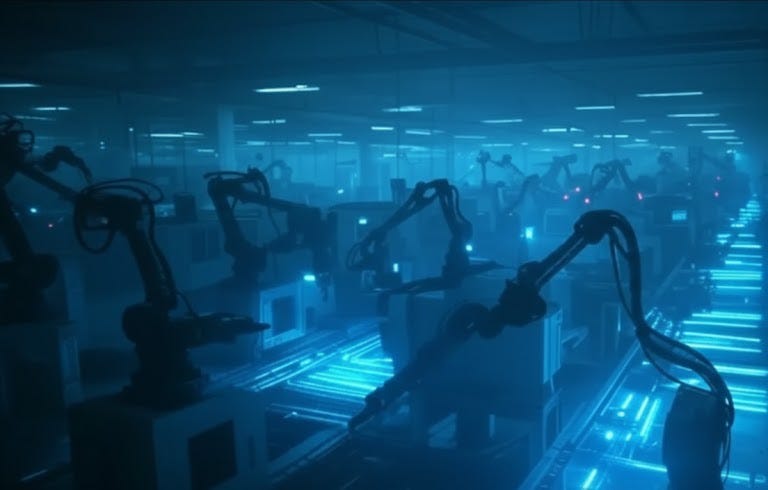
Look at what this dynamic has already produced in manufacturing. China spent decades building a commanding lead in automation, and today produces more than 70% of the world’s electric vehicles, having overtaken the EU as the world’s largest car exporter. Its state-of-the-art dark factories can churn out new products with minimal human involvement. The lesson is not that automation is bad. It is that countries and companies that build commanding leads in automation gain a structural economic advantage that compounds over time - an advantage with major geostrategic implications. As the US and China race for AI supremacy, they are building the same runaway advantage in the most valuable industries of the 21st century, distorting global trade and hollowing out industries and livelihoods worldwide.
Now project that dynamic forward. Nations in the Global South - unable to compete with AI-powered services and squeezed out of the knowledge economy that was supposed to provide their development path - face cascading economic collapse. Young people globally who grew up believing that education and hard work were the bridge to a decent life will find that bridge dismantled while they are still on it. The families who gave it their all to give their children a better life, will find the good future inexorably slipping through their grasp.
Many of you will know that feeling already. All of us can see it taking place around us.
By mid-century, on this trajectory, we arrive at something that goes beyond inequality and begins to look like economic speciation: an elite class with AI-augmented capabilities enabling lives of luxury, equipped with medical breakthroughs that deliver longer lifespans, living in parallel with a global majority whose economic prospects, healthcare access, and political power have been permanently curtailed. This is not a prediction I make lightly. We can see the forces already clearly in motion. One of the most devastating trends unfolding is the cataclysmic collapse of trust in institutions, as the social contract that binds our societies together begins to dissolve.
And government safety nets are not remotely adequate. The political class that failed to manage globalization, the 2008 crisis, social media, and Covid is now being asked to manage a transformation orders of magnitude larger.
I have sat in room after room for nearly two decades with people who are supposed to be making the plan for the future. It’s crystal clear to me now: there is no plan.
The Political and Geopolitical Catastrophe

The political rage that defines our era didn’t emerge from nowhere. It is the accumulated consequence of decades of economic dislocation - communities hollowed out, certainties withdrawn, the social contract between citizens and institutions broken again and again.
Three quarters of the world were living under democratic governance in 2000. That figure is now below half by many measures.
Now imagine what happens as the next wave of disruption arrives - not gradually but exponentially. Middle-class knowledge workers who have been the ballast of democratic stability find their career paths closing. Young people, already priced out of housing and struggling to find meaningful work, face a labor market that AI has remade without them. Communities that once organized themselves around industries that no longer need human workers have nothing to fill the void. The demagogues of today will look restrained compared to what fills that space.
The race for AI supremacy is simultaneously a race for economic dominance, military power, and geopolitical leverage - and its dynamics will reshape the international order in ways that dwarf anything that has come before. Nations that cannot keep pace will find themselves dependent on those that can, compelled to accept terms of access to AI capabilities they did not help build and cannot control. A new era of techno-colonialism is emerging, in which the currency of global power is no longer resources but compute and data, concentrated in a handful of corporations. Hand over your minerals. Rewrite your trade rules to suit Washington or Beijing. Rewrite your societies.
It doesn’t sound so far-fetched after the last several months, does it? Our leaders might be so desperate to hold on to a dying world order, we might even pretend these threats look normal.
The post-war architecture is buckling. The UN Secretary-General warned in January 2026 that the US is placing its power above international law - weeks after American forces struck Venezuela in a raid reportedly using AI tools in its planning. More than 130 million refugees are now on the move worldwide - more than in both World Wars combined.
Ukraine has become the first full-scale drone war in history - a conflict that has radically transformed the nature of warfare. What began as commercially available drone technology has rapidly become a testing ground for increasingly autonomous AI systems. Russian operators have used AI-guided targeting to hunt civilians in what Ukrainians call “drone safaris”, circulating kill footage on social media. Israel’s military AI targeting system used in Gaza generated 37,000 strike recommendations, with human operators averaging around 20 seconds per decision. Military lawyers rewrote the rules of engagement to accommodate the throughput of AI-enabled targeting - reducing safeguards against civilian casualties to match the speed of systems no human could oversee. This is not a future scenario. No Terminators required. It is the present state of AI-enabled warfare. And in the United States, AI-powered surveillance tools have been deployed to track not only undocumented immigrants but protesters exercising their constitutional rights. This is the architecture of political surveillance, built in plain sight.
No nation wins in this world. A society that prevails in the AI arms race while its institutions and values corrode and its citizens rage has lost everything.
The Climate Crisis Compounds Everything

The emissions trajectory we are currently on points toward almost 3°C of warming above pre-industrial levels by century’s end - a catastrophic level of heating. At 2°C, roughly one third of the world’s population faces severe heat stress. At 2.5°C, large portions of South Asia, the Middle East, and sub-Saharan Africa become seasonally uninhabitable without air conditioning. Beyond 3°C, crop failures become frequent, monsoon systems that billions depend on become unpredictable, and the Amazon rainforest crosses its tipping point, initiating a dieback that releases vast carbon stores and cannot be reversed. Already, 150 species are going extinct daily and nearly half of all species have lost some of their populations due to climate change. Up to 29% of all land species vanish. Half the world faces serious climate risk within the lifetimes of children already alive. Our failure to cut emissions earlier means we must now make enormous cuts with almost no time to spare: a 42% reduction in greenhouse gas emissions by 2030, 57% by 2035, and Net Zero by 2050.
And here is what makes this simultaneously more urgent and more maddening: even optimistic scenarios for AI-driven economic growth make the climate crisis dramatically worse, not better. Every projection of AI-powered productivity growth assumes exponentially greater economic activity, resource consumption, and energy use. Data centers already consume 1-2% of global electricity; by 2030 that figure is projected to reach 8%. AI training runs now consume as much power as small cities. Efficiency gains are being swamped by the sheer scale of expansion. The net effect is more energy use, not less. And as AI fuels economic growth, it drives a boom in consumption that compounds the crisis further: between 2018 and 2024, the world consumed more than 500 billion tonnes of materials - around 28% of all the materials humanity consumed in the entire 20th century.
The innovations that are supposed to save us are too slow to arrive in time. Fusion will happen but will likely take decades before it is perfected and deployed at scale - the director of Lawrence Livermore National Laboratory, which achieved the first net energy gain from fusion in 2022, says a full-scale commercial plant is “probably decades” away. Carbon capture eliminates just 50 million tonnes annually against more than 40 billion tonnes of emissions. The technology companies are aware of this. Their answer is efficiency - and it is true that successive hardware generations are getting significantly more efficient. But there is no credible pathway to reconciling AI’s projected demands, and a turbocharged global economy, with the decarbonization targets the science says are necessary - and the investment in climate adaptation that societies around the world need but are failing to achieve. New crops, new flood defenses, new freshwater sources, new homes, entirely new ways of living and working are needed. Tell me more about how AI will solve those things in time to give billions of people the good future?
The refugee crisis connects everything. At 130 million displaced people, the world has already seen the political consequences: entire movements across the Global North built on anti-migrant rage, humanitarian frameworks strained to breaking point. Now consider what happens when climate breakdown, economic collapse, and political disintegration converge across entire regions - hundreds of millions more people on the move. At 130 million, compassion and democratic resilience are already fraying. What happens at ten times that number?
The chain of consequences is not speculative. It is the logical extension of where we already are. I have been in meetings with architects of AI policy where climate was dismissed with a wave of the hand. The irony is almost unbearable: the same people celebrating AI’s potential to transform medicine and science are dismissing the environmental catastrophe that will render so much of that transformation irrelevant.
These are not separate problems. They are the same problem, viewed from different angles. And the most dangerous intellectual failure of our time is the insistence on treating them as if they were not.
The Failure of Elites
I have spent nearly two decades in the rooms where these decisions are being made. I need to tell you plainly what I found there.
Not scheming masterminds. Intelligent, driven people operating without a coherent vision of where we are headed - and profoundly incurious about the full consequences of what they are building.
In the technology industry, I found utter faith that problems are technological in nature and therefore technology is the solution. Leading figures tout post-scarcity economics where unworkable hand-wavy economic thinking magically solves all of our problems. Any conversation about how to solve our energy needs or tackle climate change involves simply building fusion reactors. We have a more than $110 trillion global economy. The Global South needs $1.3 trillion annually for climate adaptation, and rich nations refuse to provide it. So show me the mechanism by which AI magically delivers broad-based prosperity. I want the plan. I want the receipts.
In political circles, every complex challenge is met with another narrow regulatory intervention obsolete before it passes into law. Some of these interventions are based on staggering ignorance of the technologies they seek to manage. A few months ago one major European political leader asked me to explain what an AI agent was. I met with one politician this year who had drawn up a list of economic growth policies, none of which referred to AI at all. “You elected people to fix potholes and now you’re asking them to solve the problems of human civilization,” a member of the UK parliament complained to me.
“You aren’t even good at fixing the potholes,” I replied.
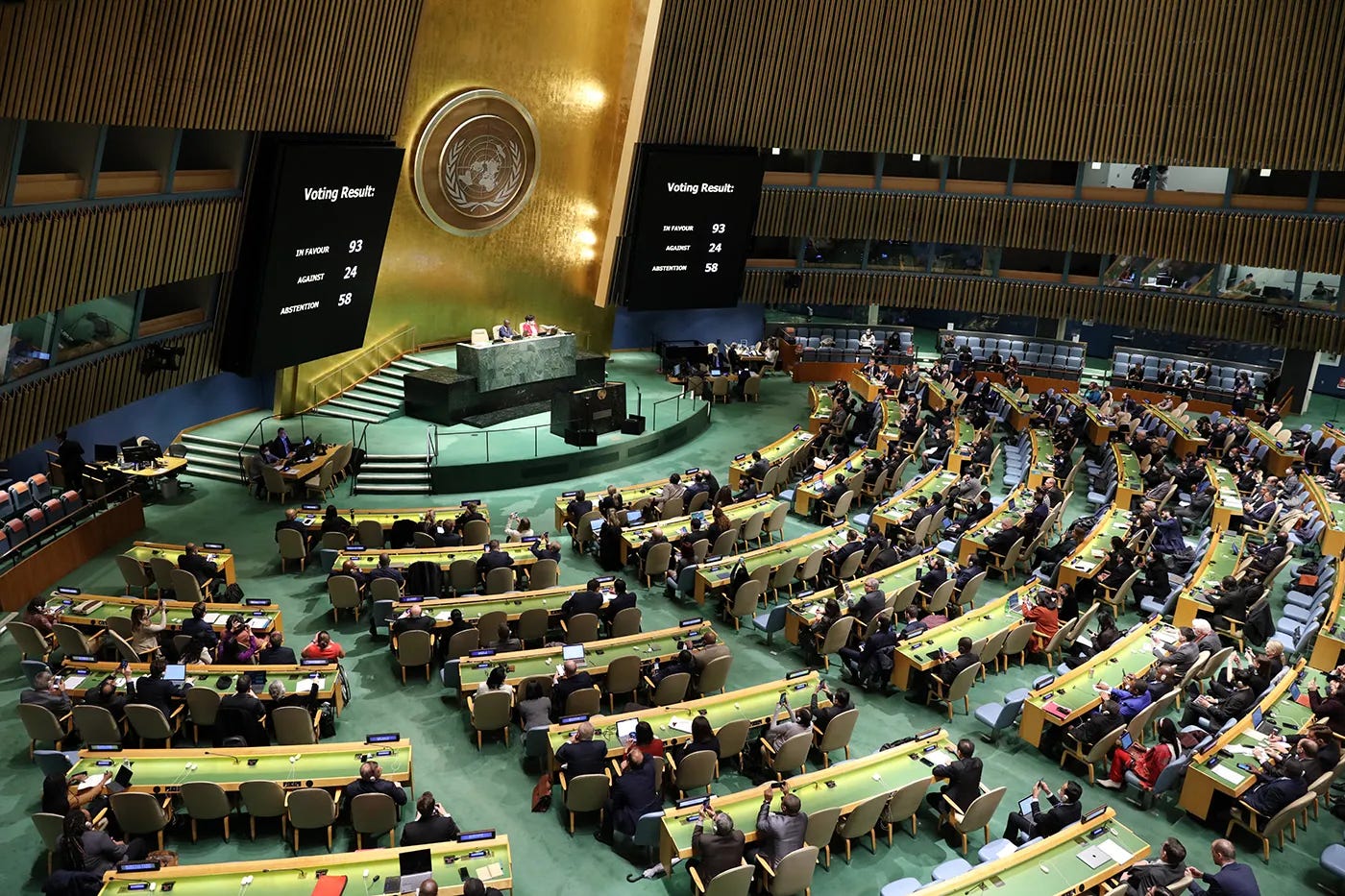
At the UN, I found people who understood the scale of the problems but were trapped in performative responses that changed nothing and a Security Council so broken that it cannot respond to any crisis involving a permanent member. Today, the mood among many diplomats is simply despair. Even the performative responses have become impossible in a global order now teetering on the brink.
So on and on, the leaders and institutions that held together the global order we all grew up in, are flailing or retreating. In another post, I’ll spend more time talking about the dysfunctions of elites as I’ve seen them during my last couple of decades. A refusal to take the future seriously at all, by leaders who simply have not done the work to understand what is coming and are governing on the basis of a world that no longer exists, is probably the most deadly of the dysfunctions. One-dimensional thinking - the inability to see these crises as a single interconnected system rather than isolated problems to be solved in silos - is almost as dangerous in the way it warps decision-making. And saddest of all is the fatalism among those who do understand - a conviction that these forces are intractable, that the future is a tidal wave and we can do nothing but brace for impact.
But the future is not a tidal wave. It is the future. And we have choices.
“If you wish to understand what Revolution is, call it Progress; and if you wish to understand what Progress is, call it Tomorrow.” - Victor Hugo
The Future We Could Build
I want to stop here and say something I believe with total conviction.
We are not destined to fail.
The future is not something that happens to us. It is built - through choices, through institutions, through the vision we decide to act on or abandon. Every catastrophic outcome I have described is the consequence of choices still largely reversible. Every transformational good outcome is the consequence of choices still largely available.
A New Economic Model for the AI Era

The question is not whether AI will displace workers - it will. The question is whether the vast economic surpluses it generates are captured by a handful of companies and shareholders, or redistributed in ways that ensure everyone shares in the abundance. What could we build, in place of the existing economic system, that gives us and our children lives of far greater liberation and fulfilment?
Children grow up with animating dreams of the people they want to be. At some point they usually give up those dreams to settle for jobs and careers that are achievable and pay the bills. But what if they didn’t have to? What if we chose to build a future where we deliberately seek to use technology to liberate humanity from settling? What if our children got to become the people they truly wanted to be, and to choose occupations and lives that gave them far greater meaning rather than simply to survive?
I think we should choose that future. Instead of just waiting for our societies to founder in the backwash of AI, we should set out an explicit vision for how to give our children the future we wish for them.
This requires a new social contract - one that separates human dignity and security from productive output. That ensures people can live well regardless of whether machines have made their particular labor redundant. This means progressive taxation of AI-powered corporations. It means well-funded transition support for displaced workers. It means, in many contexts, Universal Basic Income - unconditional support that allows people to meet their needs and pursue meaningful lives even as the labor market transforms.
Using the dramatic economic surpluses AI will generate, governments fund a new kind of freedom - not freedom from work entirely, but freedom from working simply to survive. Freedom to redirect human energy toward the things that make life worth living: care, creativity, community, curiosity. The kinds of things that my parents worked themselves to the bone for forty years without ever quite having space for.
I think about my mother, who asked through tears upon retiring: “Now what am I supposed to do?” What might have blossomed in my father, if he had discovered painting thirty years earlier, not just in the final years of his life? What ideas, what joy lies dormant in billions of people who have never had the luxury of asking what they would do with time they could genuinely call their own?
The same economic surpluses, harnessed through new public frameworks, can fund a great generational project: rebuilding communities hollowed out by dislocation, transforming education and healthcare, restoring the public infrastructure that gives ordinary life its dignity. This is not utopia. It is a political choice. The resources exist. What is missing is the will and the plan.
A New International Order

Of course, there is no version of a stable AI future that any single nation achieves alone. The US-China arms race doesn’t produce a winner. It produces a world in which two great powers exhaust themselves and destabilize everyone else. The critical solutions we need for our future, from UBI to revitalized climate action, probably won’t work without vast international cooperation to unlock the necessary resources and coordination.
What we need is something like a Global Marshall Plan for the age of AI - sharing breakthrough technologies and economic surpluses across borders, rather than hoarding them as instruments of dominance. The richest nations commit to supporting the rest: clean energy flows across borders; AI-generated surpluses fund a multi-generational project of rebuilding communities, restoring ecosystems, transforming healthcare and education where they are most needed. Meaningful work - not the grinding scramble of gig economies, but genuine contribution to the great project of building a better world - is in no short supply for a century of such effort.
This requires international frameworks governing autonomous weapons and AI surveillance before they proliferate beyond control. It requires reimagining international institutions for the era we are actually entering. The genius of genuine diplomacy has always been helping nations see that their interests are better served by cooperation than competition. That insight has never been more urgently needed.
We must stop thinking about the solutions for a technological future as mainly disconnected local or national efforts simply because they are more convenient and achievable. If we do not urgently place adaptation of our international system at the heart of how we manage AI, billions of people will face a devastating future. But if we work together as a world, then technology can help us to lift all nations.
A Sustainable Future

The AI transition and the climate transition are not competing priorities. They are the same imperative, seen from different angles. Managed together, they open a genuinely extraordinary possibility. Managed separately - or, worse, in opposition - both fail.
AI, deployed within the right political and economic architecture, could compress decades of clean energy development into years. Researchers have already used AI to identify hundreds of novel materials that could dramatically improve solar efficiency and battery storage. Precision agriculture guided by AI is beginning to show how food production can be dramatically transformed - higher yields, lower emissions, far less land use - if the technology is deployed in the service of food security rather than just corporate margins. A genuinely decarbonized global economy is within technological reach in a way it simply was not twenty years ago. The obstacles are not technical. They are political and economic.
A Global Marshall Plan could address all of these directly. A global architecture that shares AI capabilities and economic surpluses across borders also becomes the vehicle for sharing clean energy technology, funding climate adaptation in the Global South, and building the resilient agricultural and water systems that billions of people will need. Nations that previously faced a binary choice between development and decarbonization discover a third path: AI-powered clean development, funded by the surpluses of the technology transition.
This is what genuine sustainability looks like in the age of AI - not constraints on growth, but a transformation of what growth means and who it serves. The natural world that my parents’ generation inherited, and that mine has watched retreat, could be restored. But only if we connect the technology revolution to the ecological imperative.
Introducing the Center for Tomorrow

I recognize what you may be thinking. A new economic model, a Global Marshall Plan, reimagined international institutions - none of this is on the agenda of any major government. The political window seems closed before it opened. You are right. These ideas are not realistic given where we are now. That is precisely why the bad future looks like the most likely one. The vested interests that benefit from the current trajectory are powerful and entrenched. The bad ideas are winning.
It’s also worth pointing out that even as I have sketched out some of the broad categories of solutions - new economic models, global cooperation frameworks, AI-powered climate transitions - I do not have the answers. Nobody does. Making any of these ideas workable will be among the hardest research and political exercises in history. The sheer complexity of the challenges we face - the number of variables, the competing interests, the speed of change - means that the solutions do not yet exist in any ready-to-deploy form. They need to be built, tested, refined, and built again, with urgency and intellectual honesty about what we don’t yet know.
But what we cannot afford to do is wait until the crises are fully upon us before beginning that work. The window for change is narrowing, so we need to start now. And we need to make the case for a different future and illuminate the real choices open to us as societies, so that we can build a very different public agenda.
That is what the Center for Tomorrow exists to do. We are building rigorous, interdisciplinary research and practical solutions - treating these interconnected challenges as what they are, not as isolated technical problems but as profound human and societal ones requiring tangible answers. We are exploring partnerships with leading academic institutions and civil society organizations to produce the actionable frameworks governments, businesses, and communities actually need. We are building a global community of people who understand what is at stake - not just elites and policymakers, but the broad coalition that must be at the center of these choices. We will be running immersive leadership programs - workshops, retreats, and scenario simulations - that equip individuals across every sector with the interdisciplinary knowledge and collaborative networks the next decade demands. Not just executives or policymakers, but anyone who wants to contribute to shaping the choices ahead.
The Center launched today. We are UK-based, but global in scope. We accept no funding from Big Tech companies. They have more than enough say on the issues. Now it’s your turn.
What I Am Asking of You
There is a narrative that the future is something that happens to us - that AI’s trajectory is inevitable, that the role of citizens is to adapt to whatever the most powerful decide to build. This is the most convenient story available to those who benefit from your passivity.
I am on the road constantly now talking about the issues I’ve just laid out in this post. Everywhere I go, people ask me for advice on what they should do differently in their lives to prepare for the future, how should they think about things. Here are some obvious, simple things you can do to start (I’ll be sharing a lot more as the Center gets rolling):
Form your own serious view of what is coming. You don’t need to agree with everything (or anything) here. But you need a credible thesis about the future - based on the full landscape, not just the narrow slice you already care about. Make up your own mind on what you think is happening, so you can act in time.
Think far longer-term. Decisions being made in the next decade will determine the world your children inherit. If you have kids today, they’ll hopefully be alive 100 years from now. A radically better future is within their grasp, and I think it’s worth doing everything humanly possible to achieve this - especially when the alternative path is so clear.
Connect the dots. You cannot have a view on AI, or effective solutions for our societies, without a view on inequality. Or on climate without understanding geopolitics. The one-dimensional thinking of our current elites is what got us here. Escaping it is what gets us out.
Subscribe to this newsletter. Join the community at centerfortomorrow.com. And share this piece with people who need to read it.
Victor Hugo wrote that “utopias run in pipes” - that progress depends not on grand visions alone, but on investing in the unglamorous, unseen infrastructure that makes a different society and different lives actually possible. Now we are being asked to build those pipes for the future - to invest in things we might not have cared about before, and achieve things which look deeply inconvenient or impossible - because they matter for our progress as a civilization. Indeed, the arrival of AI and all the myriad potential paths that end in disaster or in wonder, show us that we are being asked to build a true and durable human civilization now - to step beyond the splintering wreckage of the old world, that was never capable of delivering the good life for most of its people, and to build something vastly better. If you ever wanted your life to have meaning, if you ever wanted to give it all for something real, then that should be a highly energizing possibility.
We are being asked now to fight for the good future. The window is still open. Let’s build the world we want, while we still can.
Dex Hunter-Torricke is Founder and President of the Center for Tomorrow. He spent nearly two decades at the intersection of technology and international affairs, and is the author of the forthcoming book All The Worlds We Build. The Center for Tomorrow launched today at centerfortomorrow.com.
What an excellent read!!
Agree and have been trying to spread similar messages for the last two and a half years or so... Please say if I can be of any support at any stage, I believe in this mission 🥰🌸